


Happy Family Happy Family
Take back your everyday.

Treatment for Back Pain

The back acts as the body’s main support structure, with the lumbar area (lower back) carrying much of the body’s weight and the thoracic region (mid-back) providing upper body stability and helping maintain proper posture.

Because the back facilitates so much movement, it is susceptible to back injuries and conditions such as spinal stenosis, herniated discs, compression fractures and more. Many of these conditions can cause debilitating pain, limited mobility and, in severe cases, paralysis. If you or a loved one is experiencing back pain accompanied by radiating discomfort, numbness or decreased function, it’s important to seek medical care.

During your appointment, your back specialist will review your medical history and perform a physical examination to evaluate your pain level, strength and spinal mobility. In many cases, additional diagnostic testing may be recommended.

Connect with our Spine SpecialistsContact Icon
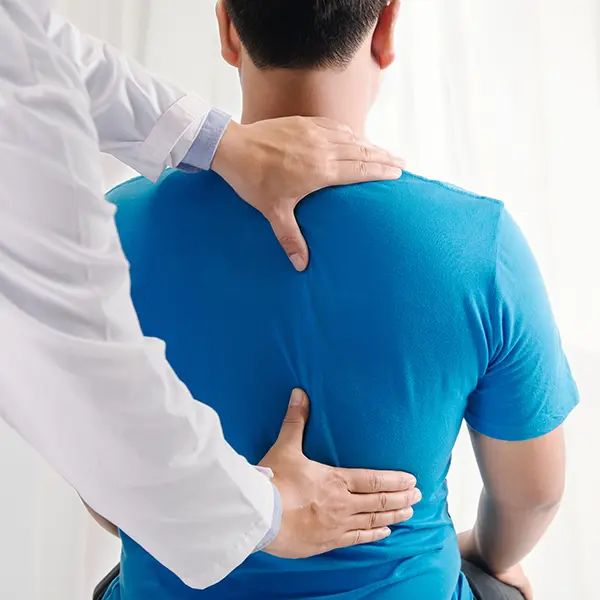
Image of doctor checking patient's spine

Diagnostic Testing

Imaging – Used to visualize the spinal cord, nerves and surrounding structures, and to identify any compression or structural abnormalities:

    • X-ray
    • CT (Computed Tomography) Myelogram (performed with contrast dye)
    • MRI (Magnetic Resonance Imaging)

Electrical Testing – Electromyogram (EMG) to assess nerve function and identifies nerve irritation or damage.

Blood Tests – To detect inflammation or infection that may be contributing to your symptoms.

Treatment Options

After reviewing your diagnostic results, your provider will determine the most appropriate treatment plan based on your condition and symptom severity. Depending on the location and severity of your back pain, nonsurgical or surgical options may be considered. While more serious spinal conditions may require surgery, we offer less intensive treatments for milder conditions. Our team is also trained in minimally invasive and endoscopic spine techniques to use when appropriate. At Specialty Orthopaedics, our spine specialists work closely with each patient to create a customized plan tailored to their specific needs and goals.

Non-Surgical Treatment

Prescribed Medications

Medications such as anti-inflammatories, muscle relaxants, pain relievers or steroid medications to reduce swelling and discomfort.

Heat and Cold Therapy

Start by applying cold compresses and then alternate hot and cold throughout the first 24–48 hours to minimize inflammation and pain.

Activity and Lifestyle Modification

Modify lifestyle and daily activities to avoid movements that aggravate symptoms.

Physical Therapy

Participate in physical therapy to improve posture, strengthen supportive muscles and maintain flexibility.

Supportive Devices

A back brace or lumbar support may be recommended to limit motion, reduce pressure and provide stability (used only when medically appropriate).

Injection Therapy

Your provider may recommend epidural steroid injections to reduce inflammation around the spinal cord and irritated nerves.

Surgical Treatment

If symptoms are severe, involve significant nerve compression or fail to improve with conservative care, surgery may be an appropriate option. Our spine surgeons use various surgical procedures to relieve spinal cord and nerve pressure, improve function and maintain mobility in the thoracic and lumbar spine.

Prodisc L Total Disc Replacement

An artificial disc implant inserted through a midline, mini-open approach to replace a damaged lumbar disc and preserve spinal balance and motion. It serves as an alternative to lumbar spinal fusion.

Learn More About Prodisc L Total Disc ReplacementArrow Icon
Posterior Spinal Fusion

Performed through either an open midline incision or a smaller minimally invasive incision, this procedure approaches the thoracic or lumbar spine from the back of the body. Spinal hardware (screws, rods and locking caps) is inserted through the pedicles—the sturdy cylinders of bone on each side of a vertebra—into the vertebral bodies to restore posture and facilitate fusion.

Lumbar Artificial Disc Replacement (ADR)

A motion-preserving alternative to fusion. A prosthetic disc is placed in the damaged disc space, allowing the neck to retain more natural movement while relieving pressure on nerves.

Learn More About Lumbar Artificial Disc ReplacementArrow Icon
Anterior Lumbar Interbody Fusion (ALIF)

Performed through a small incision in the lower abdomen below the belly button, this procedure allows access to and removal of a damaged disc to relieve nerve pressure. Specialty Orthopaedics uses a mini-open, muscle-splitting approach to preserve the surrounding muscles. After the disc is removed, an interbody cage with bone graft is placed to restore spinal stability and recovery.

Learn More About Anterior Lumbar Interbody FusionArrow Icon
Lumbar Corpectomy

Removes diseased vertebrae (the bones in your spine) or damaged discs, followed by the fusion of affected vertebrae, to restore spinal stability. A static or expandable vertebral body replacement (VBR) is inserted in place of the removed vertebrae, often supplemented with a plating system.

Direct Lateral Interbody Fusion (DLIF)

A minimally invasive procedure that accesses the lumbar spine from the side, avoiding major back muscles. The damaged disc is removed and replaced with an interbody spacer and lateral plate to stabilize the spine and promote fusion.

Vertebroplasty

Treats painful vertebral compression fractures by using imaging guidance to inject a cement mixture into the fractured bone, as the cement stabilizes the vertebra.

Kyphoplasty

A minimally invasive procedure that treats painful vertebral compression fractures by inserting a balloon into the fractured bone to create space. The space is then filled with cement to stabilize the vertabra.

Thoracic or Lumbar Laminectomy (Decompression)

Removes the lamina—the “roof” of the vertebrae—to enlarge the spinal canal and relieve nerve compression. A laminectomy is often performed as part of thoracic or lumbar decompression surgery.

Learn More About the Lumbar Laminectomy ProcedureArrow Icon
Microdiscectomy (Lumbar Decompression)

A minimally invasive technique using a small incision and specialized tools to remove the herniated portion of the disc with minimal disruption to surrounding tissues.

Learn More About the Microdiscectomy ProcedureArrow Icon
Transforaminal Interbody Lumbar Fusion (TLIF)

Accesses the spine through a midline incision in the back, minimizing muscle disruption and nerve manipulation. The damaged disc is removed and replaced with a bone graft and spinal cage made from state-of-the-art technologies. This approach to interbody fusion is typically less traumatic to the spine, safer for nerves and allows endoscopic techniques for spinal fusion.

If you have been involved in an accident that may have caused a back injury, or if you are experiencing any symptoms including sharp and ongoing pain, contact the spine physicians at Specialty Orthopaedics. Our team provides patient-centered care focused on accurately diagnosing and effectively treating back pain.

Our Outpatient Surgery Center

Specialty Orthopaedics is pleased to offer our on-site ambulatory surgery center, where patients can receive same-day surgical care. Our center provides the convenience of surgery outside a hospital setting, allowing patients high-quality care at a reduced cost, shorter wait times, no extended hospital stays and streamlined scheduling. As the only orthopedic outpatient surgery center in Hall County, we are committed to delivering the best patient care and surgical experience.

Why Choose Specialty Orthopaedics?

Our vision is to provide excellent, patient-focused, comprehensive orthopedic care to patients of all ages across North Georgia. With more than 20 years of experience, Specialty Orthopaedics has grown to become a pillar of the North Georgia medical community with four convenient locations in GainesvilleDawsonvilleBraselton and Duluth.

Contact Us
Today

To schedule an appointment or for information about the treatment options offered at Specialty Orthopaedics, contact us today.
Back to Top