


Happy Family Happy Family
Take back your everyday.

Back Injuries & Conditions

Back pain is often sharp or aching and may radiate from the back into the hips, legs or buttocks. Posture is often affected as many patients have difficulty standing up straight due to their pain. Numbness and tingling in the lower limbs are also common and, in severe cases, weakness or even paralysis may occur.

Back pain can significantly impact quality of life, both short and long-term, and is often a symptom of an underlying issue such as degeneration, injury or trauma, overuse or strain, lifestyle factors (such as smoking or obesity), infection or structural instability. With so many potential causes, it’s important to work with your medical provider to determine the underlying issues causing your symptoms and the factors contributing to them.

Back pain can arise from several conditions affecting the thoracic (mid) and lumbar (lower) spine.

Connect with our Spine SpecialistsContact Icon
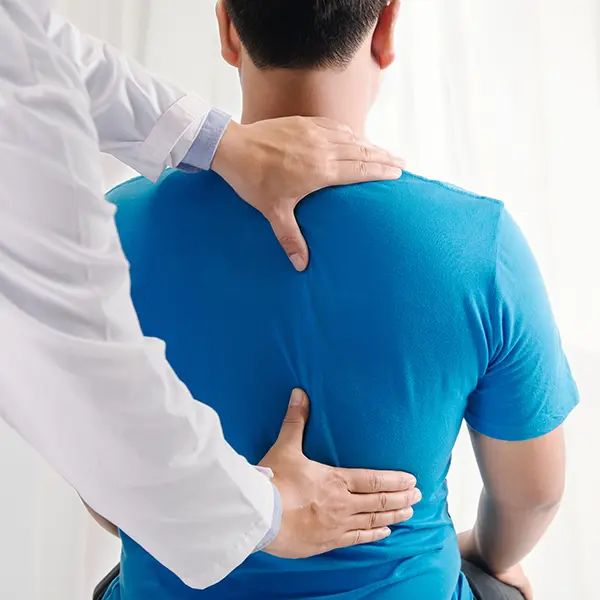
Image of doctor checking patient's spine

Thoracic & Lumbar Spine Conditions
What conditions commonly cause back pain?
Burst Fractures

A burst fracture is an injury where a vertebra, the primary bone of the spine, breaks into several pieces. The front portion of the vertebra (the vertebral body) shatters, which increases the risk of spinal cord or nerve injury. Burst fractures usually result from significant trauma, such as a car accident or severe fall.

Learn More About Burst FracturesArrow Icon
Compression Fractures

A compression fracture is a break in your vertebrae (the bones in your spine). Over time, these fractures can lead to your spine collapsing or curving as weakened bones are unable to handle normal pressure. Compression fractures are common in individuals with osteoporosis.

Learn More About Compression FracturesArrow Icon
Degenerative Disc Disease

Degenerative disc disease occurs when the cushion in your spine begins to wear away. Spinal discs act as a cushion to absorb shock between vertebrae, but a disc can lose its cushioning effect over time. The decreased cushioning lead to a loss of disc height and cause irritation or pinching of the nerves. A disc may also bulge or herniate, or the bones may start to rub together as the discs wear away, resulting in additional discomfort and nerve pressure.

Learn More About Degenerative Disc DiseaseArrow Icon
Lumbar Spinal Stenosis

Lumbar spinal stenosis occurs when the spinal canal in the lower back narrows, leading to compression of the spinal cord or nerve roots. This narrowing may develop from aging, injury or ongoing degenerative changes. Over time, spinal discs lose moisture and strength, causing the vertebrae to shift or collapse and potentially leading to bone spurs or thickened tissues that crowd the spinal canal.

Learn More About Spinal StenosisArrow Icon
Sacroiliac Joint Dysfunction

The sacroiliac joint (SI joint) connects the iliac bones (pelvis) to the sacrum, the lowest part of the spine above the tailbone. The SI joint helps absorb shock by preventing impactful forces from reaching the spine and can become degenerative during activities such as lifting, running, walking or lying on the affected side. Pain from the SI joint often feels similar to disc or lower back pain.

Learn More About Sacroiliac Joint DysfunctionArrow Icon
Scoliosis

Scoliosis is a side-to-side curvature of the spine, where the spine rotates sideways instead of forming its natural forward-and-backward curve. It often appears as an “S” or “C” shape when viewed from behind, and its severity can range from mild (about 10 degrees) to severe (100 degrees or more). Individuals with scoliosis often don’t experience symptoms but may experience discomfort or changes in posture if the curve increases in severity.

Learn More About ScoliosisArrow Icon
Spinal Tumors

Spinal tumors are abnormal growths of tissue, called neoplasms, and they are relatively rare. Neoplasms are commonly classified as benign (noncancerous) or malignant (cancerous). Benign tumors may damage nearby bone tissue but do not spread to other tissues or parts of the body. However, malignant tumors can invade the vertebrae, which are the bones in your spine, and have the potential to spread to other organs.

Learn More About Spinal TumorsArrow Icon
Spondylolisthesis

Spondylolisthesis is a condition in which one vertebra (a bone in the spine) slips or slides forward over the vertebra below it, causing spinal instability. This forward movement can compress nearby nerves or the spinal cord and lead to lower back pain, leg pain and symptoms such as numbness or tingling. Spondylolisthesis most often occurs in the lumbar spine (lower back) and may develop from sports-related injuries or age-related weakening of the bones, joints and ligaments. Genetics can also increase the risk of a spondy occurring, especially in individuals who participate in football, gymnastics and similar sports.

Learn More About SpondylolisthesisArrow Icon
Thoracic & Lumbar Herniated Discs

A spinal herniated disc—often referred to as a “slipped disc”—occurs when the soft, gel-like center of the disc (the nucleus pulposus) pushes through a tear in the outer layer (annulus fibrosus). As the gel-like substance leaks out, it can cause pressure on the spinal canal or nerve roots. Chemicals released from the damaged disc can also irritate surrounding nerves, leading to inflammation and pain. While herniated discs can occur in the thoracic (mid-back) area, they are more common in the lumbar spine (lower back), which typically experiences more stress.

Learn More About Herniated DiscsArrow Icon

Symptoms

Many back conditions share similar signs & symptoms.

Patients may experience:

  • Numbing & tingling (often in the legs or feet)
  • Back pain, either localized (in one area) or radiating (traveling from the back into the body)
  • Sharp or aching back pains
  • Muscle weakness in the legs or feet
  • Muscle spasms
  • Difficulty standing up straight or maintaining posture

In more severe cases, patients may experience:

  • Loss of bladder or bowel control
  • Loss of sensation
  • Significant balance and coordination problems
  • Weakness or paralysis in the legs

If you’ve been experiencing any of the above symptoms, especially if the pain is severe or lasts longer than a few days, contact the spine physicians at Specialty Orthopaedics. Our specialists provide comprehensive evaluations and personalized care to help you improve your quality of life.

Our Outpatient Surgery Center

Specialty Orthopaedics is pleased to offer our on-site ambulatory surgery center, where patients can receive same-day surgical care. Our center provides the convenience of surgery outside a hospital setting, allowing patients high-quality care at a reduced cost, shorter wait times, no extended hospital stays and streamlined scheduling. As the only orthopedic outpatient surgery center in Hall County, we are committed to delivering the best patient care and surgical experience.

Why Choose Specialty Orthopaedics?

Our vision is to provide excellent, patient-focused, comprehensive orthopedic care to patients of all ages across North Georgia. With more than 20 years of experience, Specialty Orthopaedics has grown to become a pillar of the North Georgia medical community with four convenient locations in GainesvilleDawsonvilleBraselton and Duluth.

Contact Us
Today

To schedule an appointment or for information about the treatment options offered at Specialty Orthopaedics, contact us today.
Back to Top